


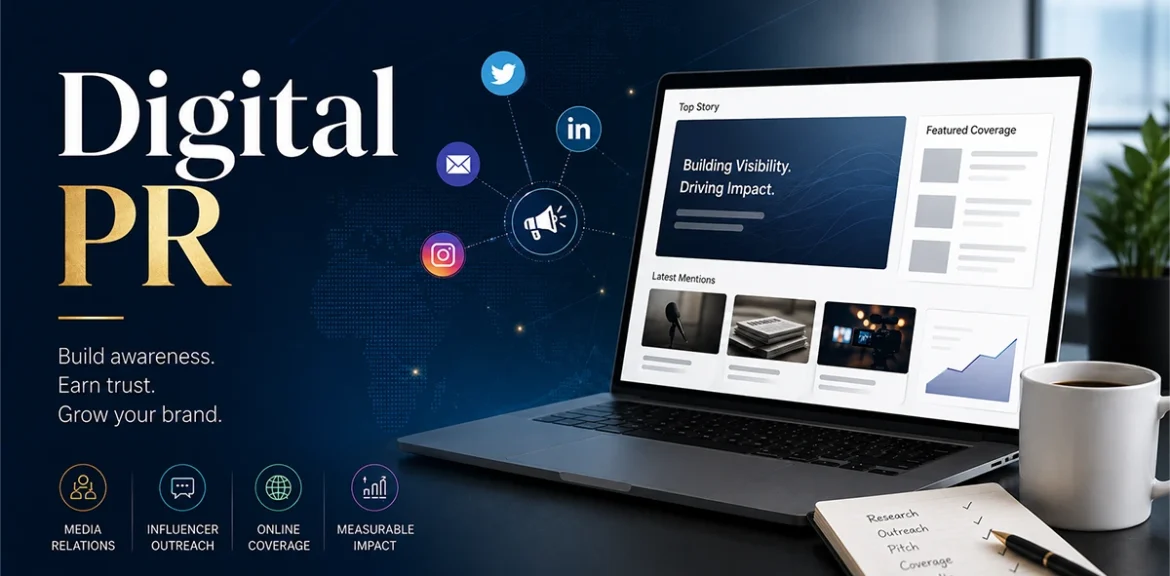
When people want to know more about a business today, they usually do not start with its advertisements, ever. Instead, they go online, read reviews, scroll through news articles, compare competitors, and try to collect opinions from sources they feel more or less trust. Those little interactions end up shaping how a brand is understood long before someone actually visits its website or decides to purchase through Digital PR.
Digital PR, in a sense, helps businesses nudge that whole perception by landing solid coverage across online publications, blogs, podcasts, and various digital spaces. Unlike older styles of PR, which mostly lean on offline media, Digital PR also supports SEO, content marketing, and brand authority.
This blog covers what is digital pr, why it matters, and how a business can form an effective Digital PR strategy.
What is Digital PR?
Digital PR (Digital Public Relations) is, basically, the art of pushing a business brand, or even just an individual, forward through digital channels to boost online presence, create credibility, pull in quality media attention, and overall strengthen brand reputation.
Instead of banking only on newspapers or television, Digital PR tends to lean on:
- Online news publications
- Industry blogs
- Digital magazines
- Influencer collaborations
- Podcasts
- Social media platforms
- Online communities
- Business publications
- Authority websites
The main aim is to win positive media mentions, attract solid high-quality backlinks, and then build durable connections with journalists, publishers, influencers, and other industry specialists.
So if somebody ever asks what is digital pr, you could say this,
Digital PR is the process of using online media and digital platforms to improve a brand’s reputation, authority, visibility, and even search engine performance.
And, unlike paid advertising, Digital PR is all about earned media. That means websites and publications feature your brand on their own because they genuinely feel your story is worth noticing and also newsworthy.
See also: Organic vs Paid Marketing: A Complete Guide for 2026
Digital PR at a Glance
| Aspect | Description |
| Primary Goal | Build brand authority and online reputation |
| Main Channels | News websites, blogs, podcasts, influencers, social media |
| Focus | Earned media coverage |
| SEO Benefit | High-quality backlinks and improved domain authority |
| Marketing Benefit | Increased trust and brand awareness |
| Long-term Value | Sustainable online visibility |
PR Full Form in Marketing
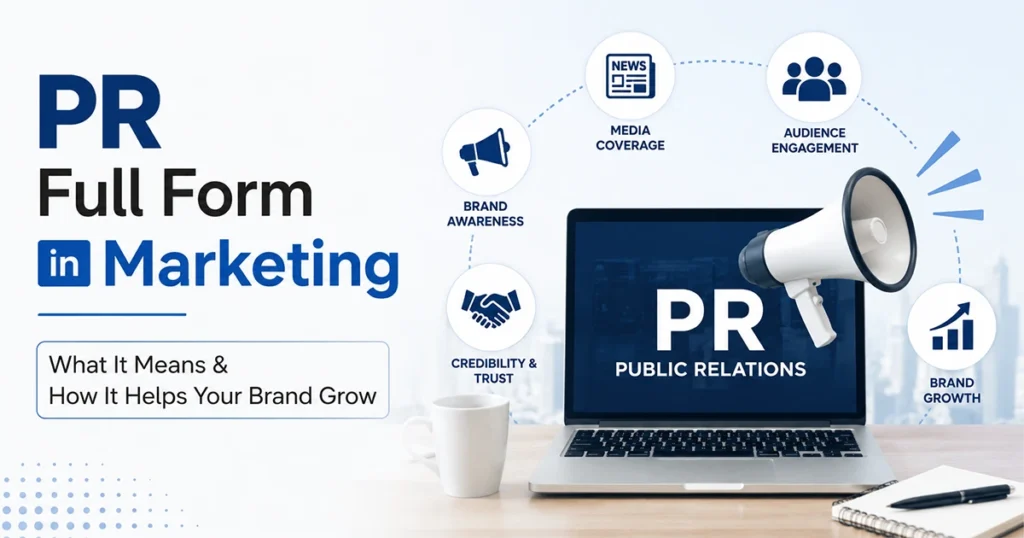
The PR full form in marketing is Public Relations.
Public Relations is basically that strategic communication method that assists organizations in building and keeping those mutually beneficial links with their intended audience, media professionals, stakeholders, investors, and the general public.
Its purpose isn’t only about pushing products around; it more or less aims to create trust, sharpen reputation, steer public perception, and also set up longer-term credibility.
In today’s digital marketing, PR comes along with advertising, producing genuine media attention instead of depending only on paid promotional campaigns.
PR vs Marketing vs Advertising
A lot of folks mix up public relations with marketing or advertising. Even though they are tightly related, they do different work, sort of like two sides that don’t really match up.
| Factor | Public Relations | Marketing | Advertising |
| Objective | Build reputation | Generate demand | Promote products |
| Approach | Earned media | Combination of strategies | Paid promotions |
| Cost | Lower direct media costs | Variable | Paid media budget |
| Trust Level | High | Moderate | Lower than earned media |
| Time Horizon | Long-term | Medium to long-term | Short-term campaigns |
That slight distinction also sheds light on why pr advertising has been getting more attention lately, where companies blend earned attention with paid promotions to stretch their brand visibility as far as possible.
Evolution of Digital Public Relations
Public relations has changed a lot , over the past two decades.
Earlier, businesses relied on newspapers, magazines, television interviews, and press conferences, but even then, it wasn’t always so simple. While these channels are still a thing, relevant and mostly useful, consumer habits have sort of shifted fast toward digital platforms instead.
Nowadays, audiences take in information through:
- Google Search
- YouTube
- Online publications
- Industry newsletters
- Podcasts
- Digital magazines
As a result, Digital PR has turned into a kind of essential piece within modern marketing strategies, honestly.
Traditional PR Era
- Printed newspapers
- Television interviews
- Radio appearances
- Press conferences
- Printed press releases
See also: What Is a Press Release in Digital Marketing? Explained
Digital PR Era
- Online media coverage
- Editorial backlinks
- SEO-focused campaigns
- Influencer partnerships
- Brand storytelling
- Data-driven campaigns
- Thought leadership articles
- Digital press releases
That shift mirrors the way consumer habits have moved lately, where people sort through information online by themselves instead of just waiting for it to show up through the usual media channels.
Why Digital Public Relations Matters Today ?
People rarely go ahead and buy something without doing a bit of online digging first.
Before they decide what to purchase, they usually:
- Read reviews
- Search Google
- Visit company websites
- Compare competitors
- Read news articles
- Explore social media
- Check customer testimonials
Digital PR then helps make sure that when prospective customers search for your business, they find information that feels dependable, credible, and authoritative.
This helps with, consumer confidence that is more solid, plus an online reputation that feels more steady. It also tends to push up search rankings, brings more visitors to your site, and boosts conversion rates too. On top of that, there’s stronger brand recognition as well, even if it doesn’t look dramatic at first.
Why Businesses Should Invest in Digital PR?
Digital PR kind of feels like it gives more than just media exposure. Like, it’s not only the headlines either; it’s also that long-term ripple, you know? The whole “talk about it now, then it keeps working later” vibe.
Builds Brand Authority
When you get mentioned in credible publications, your company starts to feel more like an actual leader in the industry. People tend to lean on brands that show up in respected news outlets; it just happens. And it’s not random.
Improves Search Engine Rankings
One big upside of Digital PR is that it supports SEO, pretty directly. After a while, established sites reference you and link back to your business. Then search engines treat those backlinks as proof of trustworthiness and credibility.
- You end up with things like:
- Improved keyword rankings
- Higher domain authority
- Increased organic traffic
- Better visibility on Google
Generates High-Quality Website Traffic
Unlike paid promotions that just stop once the budget is done, editorial mentions keep pulling in visitors for months, or even years, which feels sort of unreal at first.
That effect leads to steadier long-term traffic.
See also: How to Generate High Quality Leads in Digital Marketing?
Strengthens Brand Reputation
When you get decent media attention, it helps businesses to:
- Trust
- Transparency
- Professionalism
- Industry expertise
Consumers are much more likely to interact with brands that keep a solid online reputation, not just the loudest ones.
Supports Content Marketing
Digital PR also helps by taking useful content and amplifying it via reliable publishers, journalists, bloggers, and online communities.
So instead of everything sitting only on your site, the message travels farther, thanks to respected third-party platforms and people who already trust them.
See also: How to Boost SEO Content Writing With AI Tools?
Digital PR vs Traditional PR
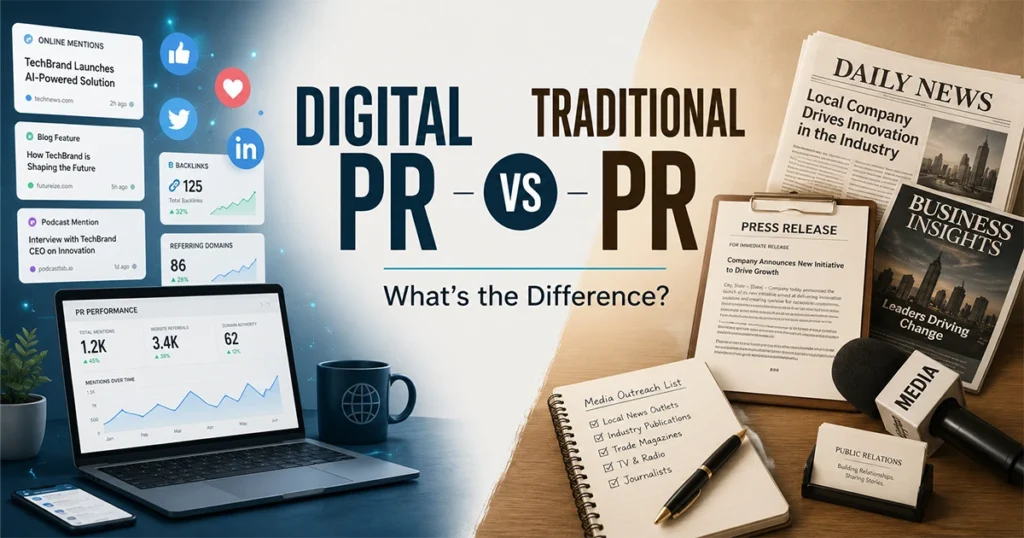
| Feature | Digital PR | Traditional PR |
| Primary Channels | Online publications, blogs, podcasts, influencers | Newspapers, magazines, TV, radio |
| Measurement | Real-time analytics | Estimated reach |
| SEO Benefits | Yes | No |
| Backlinks | Yes | No |
| Website Traffic | Directly measurable | Limited |
| Audience Targeting | Highly specific | Broad |
| Campaign Tracking | Comprehensive | Limited |
| Content Formats | Articles, videos, podcasts, social media | Print, television, radio |
| Speed | Fast | Comparatively slower |
| Longevity | Articles remain searchable online | Coverage often has a shorter lifespan |
Key Components of a Successful Digital PR Campaign
| Component | Purpose |
| Media Outreach | Build relationships with journalists |
| Press Releases | Announce newsworthy updates |
| Thought Leadership | Position executives as experts |
| Content Marketing | Create valuable, shareable content |
| SEO Integration | Improve search visibility |
| Influencer Partnerships | Expand audience reach |
| Social Media Amplification | Increase engagement |
| Brand Monitoring | Track reputation and mentions |
| Crisis Communication | Protect brand image during challenges |
How Do PR? A Step-by-Step Digital PR Strategy
A successful Digital PR campaign works best when you use a clear but not too rigid approach, with more focus on shaping useful narratives, tracking down the right audience, and then letting relationships simmer over time with the media, bit by bit, kind of.
Step 1: Define your objectives
First, choose goals that feel realistic for you, like raising brand awareness, improving SEO, generating prospects, or backing a new product launch. If your objectives are spelled out clearly enough, you can measure what’s happening, whether it’s clicking or not, instead of just guessing later.
Step 2: Understand your target audience
Figure out who your ideal folks really are, using demographics, the industry, what they care about, and also the day-to-day challenges they’re dealing with. That way, your message actually lands with the right crowd, through the right channels, and not some random noise.
Step 3: Create newsworthy content
Build content that feels genuinely helpful, for example, original research, company updates, deeper industry perspectives, or even success stories that show real results. Journalists often prefer material that’s informative and relevant instead of anything that reads like straight promotion.
Step 4: Build a Targeted Media List
Put together a messy but useful list of journalists, bloggers, editors, influencers , and publications that they really tend to cover your industry. If you do outreach that is more specific, you raise the likelihood of getting actual, good media coverage not just random mentions.
Step 5: Write Personalized Pitches
Make a pitch that’s tailored , like a hand fit message, and it should say pretty plainly why your story matters to that particular person and their audience. Generic emails… they just don’t land the same, often.
Step 6: Amplify Through Multiple Channels
Once your coverage is live, don’t stop there. Share it across social media, email newsletters, and also on your website so you can extend visibility and help audience engagement pick up.
Step 7: Measure Campaign Performance
Just keep an eye on the numbers, like media mentions, backlinks, website traffic, keyword positions, and even lead generation. That way you’ll know what actually worked, what kinda didn’t, then adjust the next strategy run.
Popular Types of Digital PR Campaigns
Businesses use a bunch of different Digital PR campaigns, kinda depending on what they’re trying to accomplish, not always the same target each time. Some of the most usual ones are below but honestly there’s overlap too.
- Press Releases: These are for sharing big company news, like product launches, new partnerships, funding updates, or those major “we did it” moments with the media, so journalists actually have something concrete to cover.
- Data-Led Campaigns: Based on original research, questionnaires, or reports—basically you create something new. That tends to pull attention from the press, plus it earns backlinks and gives SEO a nice boost.
- Thought Leadership: This is where you publish expert takes, articles, or interviews. The goal is to make company leaders look like trusted authorities, rather than just another brand talking loud.
- Expert Commentary: Brands and industry pros drop their opinions on trending matters. It improves the odds of getting quoted by journalists, which is kind of the whole point.
- Influencer Collaborations: Teaming up with influencers helps you tap into new people, and boost your presence through more real, recommendations, not just these forced ads, you know. It kinda feels natural instead of staged, even if its all planned.
- CSR Campaigns: This is mostly about corporate social responsibility, so you end up spotlighting social or environmental efforts, kind of like you are giving the audience something real to latch onto. Over time it usually helps build a better brand reputation.
- Awards and Recognition: Submitting for industry awards , or getting certifications, strengthens credibility. It also gives customers more confidence, because there’s some third party validation.
- Event PR: Promoting webinars, conferences, product launches, or networking gatherings. This usually drives registrations, media coverage, and lead generation, not just “awareness”.
- Crisis Communication: There’s a planned messaging plan here, so when negative publicity hits, the business can respond in a controlled way, and protect reputation during the messy part.
- Podcast Outreach: Appearing on relevant podcasts lets brands share insights, connect with smaller niche communities, and build real industry authority, slowly but steadily.
Essential Digital PR Tools
Having the right tools can make Digital PR campaigns a lot more efficient, like basically turning research outreach monitoring and performance tracking into something that feels less messy, even if your timeline get tight.
- Media Database Tools: They help you surface journalists bloggers, and publications that really fit your niche without burning hours scrolling through random lists.
- Press Release Distribution Platforms: They send your company announcements out to a bunch of media outlets in one go, and that boosts the chance of getting picked up.
- SEO Platforms: You can track backlinks, monitor keyword standings, and review website performance so you can actually tell what your Digital PR effort is doing for SEO.
- Media Monitoring Tools: These kind of keep an eye on online news, blog posts, and websites, so you can catch brand mentions and the actual, real outline of your media coverage.
- Social Listening Tools: These help you “hear” what’s already happening, ongoing conversations, customer mood, and those industry shifts across different social channels too.
- Analytics Platforms: They track website traffic, user interaction, referral sources, and the wider campaign results, so ROI isn’t just a random guess.
- Email Outreach Software: it makes it simpler to reach journalists by sorting your lists, sending more personalized pitches, and noting who replied (or didn’t).
- Project Management Tools: these let PR teams push initiatives along with less friction, assign responsibilities, keep watch on due dates, and coordinate in a way that avoids as many last-minute surprises
Is PR Going to Be Replaced by AI?
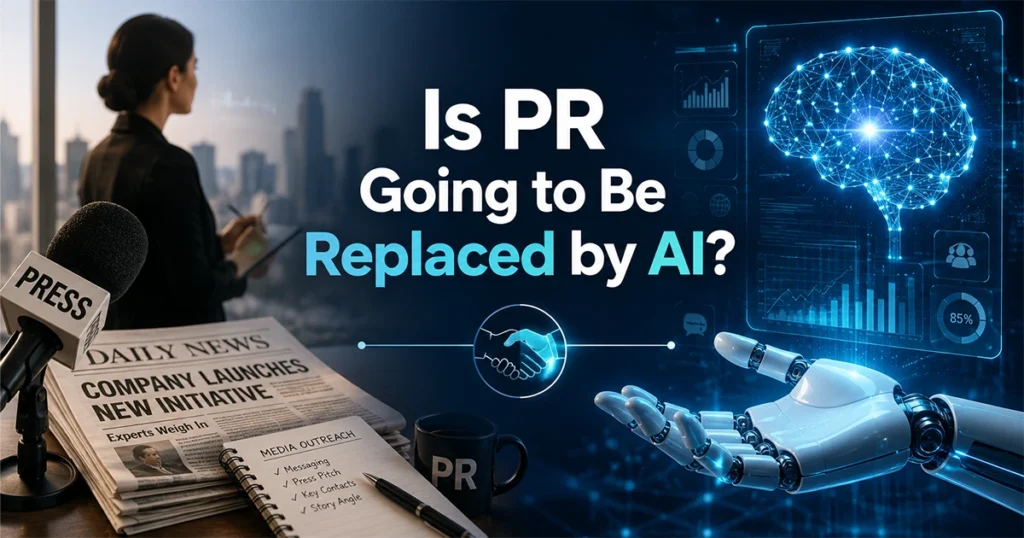
Artificial Intelligence is kinda reshaping the PR industry, though it probably won’t fully replace public relations professionals entirely. AI can take care of repeatable little tasks like: Also, it’s more about sensing when a story matters, and how to respond with careful timing, nuance, and a bit of street smarts.
- Drafting press releases
- Monitoring media coverage
- Identifying trending topics
- Analyzing sentiment
- Generating performance reports
- Personalizing outreach at scale
Still, really effective PR relies on human qualities that AI can not quite mirror, such as:
- Strategic thinking
- Relationship building
- Creativity
- Emotional intelligence
- Crisis communication
- Ethical decision-making
- Negotiation skills
- Authentic storytelling
Overall, the future looks like cooperation and a combination of both.
Overall:
Digital PR is a solid marketing approach that helps companies build credibility, get a bit more presence in search engines, and generally strengthen their online reputation through earned media, so not paid ads exactly. When you mix strategic storytelling with SEO work and media outreach, it lets brands reach sustained growth and build long-term authority in this always-shifting digital environment, which feels kinda unpredictable at times.
FAQ’s
Digital PR is basically promoting a brand using online media, blogs, influencers, and digital publications, and it needs a bit of plan energy. A solid setup usually starts with crisp goals, producing useful content, aiming at the right channels, and then tracking what happened during the campaign like performance.
A frequent scenario is a firm releases original research or announces a product launch, and then it gets picked up by news sites and industry blogs, leading to that coverage and also better backlinks that are quality.
The seven main forms of PR are Media Relations, Community Relations, Corporate Communications, Crisis Communication, Internal Communications, Investor Relations, and Digital PR.
No, even if AI can speed up things like media monitoring or sort of help with content drafts, it still can not really take over completely human creativity , those relationship-building efforts, and the real strategic picks that PR leaders make.
The five foundations of PR are Trust, Transparency, Communication, Relationship Building, and Reputation Management; each one helps support a believable and credible brand image.
For a PR professional to actually succeed, strong communication, storytelling, media relations, strategic thinking, content creation, crisis management, and digital marketing abilities really matter pretty clearly.
Yes, digital PR is worth spending on, it is because it boosts brand awareness, improves online authority , it supports SEO through solid backlinks, and it helps push long term business growth.
Digital PR can really help brand visibility, mostly by getting mentions on those respected online platforms and earning authoritative links, and then businesses can reach a wider group while also nudging search engine rankings in a better direction.
PR on social media is basically managing a brand online reputation, engaging with people, posting updates, responding to feedback, and building solid connections across social platforms, step by step, you know nothing too complicated.
Digital PR mainly focuses on online media, SEO, and results you can actually track like backlinks and website traffic, while Traditional PR leans more on newspapers, magazines, television, and radio, to create brand awareness in a more old school way.