



So, the frontend might obviously be likened to the face of a human being. On the other hand, every operation, every reasoning, and every activity comes from the brain. In the world of computers, the brain is known as the backend. Then, what is backend? It’s a collection of servers, a database, and code that help applications think, react, and adapt to stimuli.
Backend development is about creating intelligent, effective, and trustworthy processes that apply to the flow of both the user submission and one’s storage, as well as the retrieval. It’s where business logic, calculations, and validations are to happen.
This is the layer of complex operations, such as financial transactions, inventory management, and real-time analytics.
What Is Backend Development?
Backend development is the process of creating and maintaining the server-side components of web and software applications. It entails managing databases, servers, application logic, and APIs that essentially work in the shadows to hold the frontend of an application. The frontend has everything that users interact with, while the backend serves to store and retrieve data and apply business rules that provide dynamic functionality.
A common scenario in a web application would be the case that, once the user fills a form or requests some data, the front end issues a request to the backend server.
The backend will fetch the request and will retrieve or modify the data from the database, run any necessary computations, and finally send a response back to the frontend. These requests that fly back and forth seamlessly create their responsive, interactive, and dependable mechanism.
See also: Flutter vs React Native Future: What the 2025 Market Tells Us
What is The Role of a Backend Developer?
Backend development is that domain of the profession in which the developer has to build the application back end and support its maintenance; typically, this involves concerns about server-side logic, databases, and a high concern about secure API maintenance and support. These link the UI with the data, making applications able to work without dysfunction caused by heavy traffic or user interaction.
Other jobs assigned to backend developers:
- Create and develop server-side logic and database schemas.
- Write and integrate third-party services using APIs.
- Optimize the server performance based on scalability and security.
- Manage user authentication and authorization within the server.
- Debug and maintain server-side code.
- Ensure data integrity and security.
Popular Backend Technologies
Various back-end technologies and frameworks are employed by developers to ensure resiliency for their back-end systems. Some of these include:
Programming Languages
JavaScript (Node.js): Promises to maintain concurrency in request handling owing to its asynchronous ature.
Python (Django, Flask): With its rapid prototyping and readable code features, Python frameworks simplify back-end task automation from there on easy with the main reference identifiers being Django, Flask.
Java: developed mainly for support in stability and scalability in large-scale enterprise applications, one of the commonly used Java back-end technologies is Spring Boot.
PHP (Laravel, Symfony): Mostly applied in particular web developments such as CMS and E-commerce applications.
Ruby: (Ruby on Rails): Speeds up the development process since it offers the convention-over-configuration model.
Databases
Relational Databases: MySQL, PostgreSQL, Microsoft SQL Server
NoSQL Databases: Some examples of NoSQL databases are MongoDB, Cassandra, and Redis.
Web Servers
Apache HTTP Server:
Nginx
Version Control System
Git, along with repositories such as GitHub or GitLab
Containerization and Cloud Services
Docker, Kubernetes, AWS, Google Cloud Platform
See also: Web App vs Website: What’s the Real Difference
Backend Web Development vs Frontend Development
Backend web development specifically deals with developing server-side logic for the functioning of websites and web applications. Front-end deals mostly with the design and user experience and user interaction through HTML, CSS, and JavaScript frameworks. On the contrary, backend methods deal with processing, storing, and serving the data to the front end.
Back-end developers deal with databases and API as well as server configuration, which are usually instinctively hidden from an end user, yet they are most critical to the functioning of any application. The differentiation of front-end and back-end allows developers to specialize in any field, and the efficiency of development cycles is enhanced by specialization, which is directly tied to scalability.
What Is Backend in Web Development – Meaning and Examples
The backend in web application development is simply referred to as the engine room of a website or application: it is the server, the database, and the application logic that make it possible to process user input and output.
Illustration of backend processes in online shopping:
- The user chooses a product to buy and clicks the Buy Now button.
- The front end accepts user input and requests a backend server.
- Such a server recognizes the user, verifies an inventory check through the database, calculates a price, discounts it, and processes payment.
- Upon completion, the backend message is sent back to the frontend to display to the user.
That way, it could be perceived as a simple interface with a backend working quietly in synchronization for a good and responsive user experience.
See also: Backend Languages List: Top Backend Languages & Frameworks
What Skills Are Required for a Backend Developer?
To be a successful backend developer, you need to combine technical skills with problem-solving powers. Here are the most popular skills:
Fluency in Backend Programming Languages: Java, Python, Node.js, Ruby, PHP
Database Management: Designing and interfacing with internal and NoSQL databases.
API Development: Creation of RESTful and GraphQL APIs for data transfer.
Version Control: Git proficiency in code management and collaboration.
Server Management: Understanding of web servers such as Apache and Nginx.
Best Practices for Security: Understanding of encryption, authentication, and common exploitations like SQL injection.
Understanding of data structures and algorithms: Very important.
Knowledge of DevOps Tools as Docker, Kubernetes, and Jenkins for CI/CD pipeline.
Back End Frameworks – Choosing the Right Tool
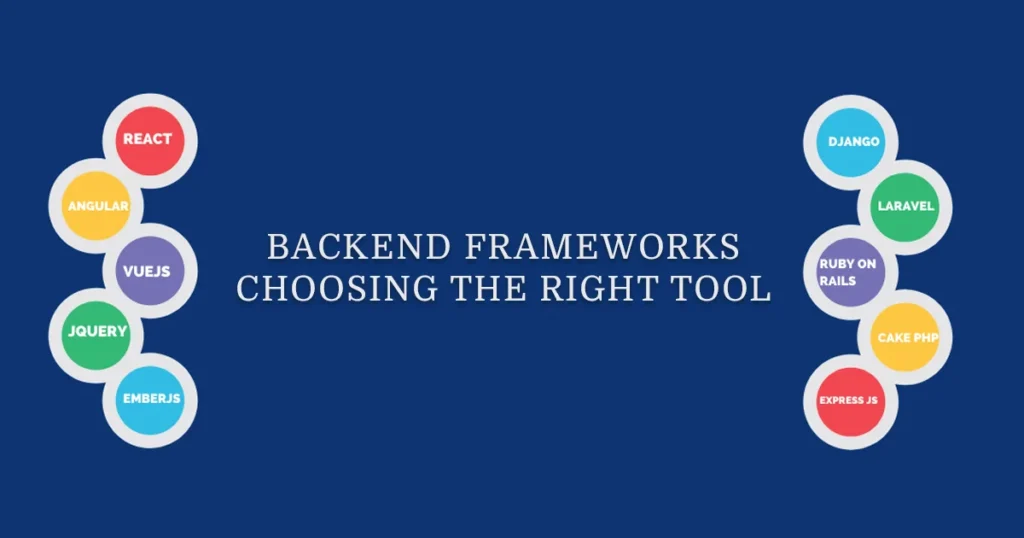
Frameworks accelerate backend development by providing reusable code structures, conventions, and standard patterns. Some popular backend frameworks are listed below.
Django (Python): Famous for its security and speed of development.
Express.js (Node.js): A minimalist and flexible framework for fast API development.
Spring Boot (Java): It is primarily used at an enterprise level with very complex architecture.
Laravel (PHP): Ease of managing complex web tasks is possible with its various built-in features making it the intelligent way to do so.
Rapid development cycle with maximum use of convention against configuration is the advantage with Ruby on Rails.
Choosing a back-end framework should also take into consideration the factors already mentioned: size of project, types of traffic expected, level of security required, and level of expertise among the developers.
See also: Frontend vs Backend Development: Key Difference & What to Learn First
Which Language Is Required for Backend?
No one programming language is compulsory for backend development, but there are many famous giants in this aspect, where their presenSce is a result of their maturity and support from various communities. Among various coding languages popular for backend development are:
Node.js is JavaScript leading candidate among event-driven architectures and convenient to use the same language on the front end and the back end.
Python is said to be quite simple and well supported by the community; very popular among startups and data-based applications.
Java is declared best for large-scale enterprise applications on account of being durable and high-performance.
PHP is still widely used by online applications, especially in CMS like WordPress.
Ruby-again, the popular usage development in rapid human prototypes using Ruby on Rails.
Every language has its advantages regarding performance, scalability, and ease of development, and usually this choice is made according to project specifications and developer familiarity.
It is, thus, appropriate to say that the backend definition goes beyond a classic formulation. It is of extremely great importance in software or web development because it does all the programming heavy lifting behind the scenes, from handling data storage to executing business logic behind the scenes and ensuring secure API communication between client and server.
With necessary programming language skills, database management understanding, security best practices, and some understanding of various backend technologies and frameworks, aspiring backend developers must possess these skills. Professionals can do much to design modern, digital, compliant, scalable applications by mastering backend development.
Now is the time when businesses and developers will practically consider it a necessity instead of an option to invest in strong backend solutions to enable the creation of seamless, scalable, and secure digital user experiences.
See also: Static vs Dynamic Websites: Which One is Right for Your Business?