


AI-powered search is changing the way people find brands online. Right now, users are basically just as likely to ask ChatGPT, Google AI Overviews, Gemini, or Perplexity for recommendations as they are to do a normal search on Google which increases brand visibility in AI search.
So this shift means businesses should think past the usual SEO. Boosting Brand Visibility in AI is now about more than keywords. You need trustworthy content, stronger brand authority, and to make it easier for AI systems to recognize you and then recommend your business.
This blog walks through how AI search works, why brand visibility is such a big deal, and the practical steps you can take to raise your presence across AI-powered search engines in 2026.
See also: What Is an AI Search Engine and How Does It Work in 2026?
Quick Answer
Brand Visibility in AI Search is about how often and how on point AI-powered search tools mention, hint at, or bring up your business when people ask questions.
To boost that visibility, you usually need a bit of everything, like good content, technical SEO tweaks, structured data, credible third-party mentions, solid brand signals, and the same consistent business info repeated across the internet.
Companies that put time into AI Search Optimization are more apt to show up inside AI-generated answers and meet customers sooner, often before they even fully reach that buying moment.
Key Takeaways
- AI search engines recommend brands based on authority, relevance, and trust.
- Traditional SEO still matters a lot, but AI search seems to lean on extra quality indicators too.
- When you get strong brand mentions across trusted websites, that boosts your AI Brand Visibility.
- Having structured content helps AI models understand what you know and where you’re good.
- Entity optimization is starting to feel as necessary as keyword optimization.
- Tracking AI Search Visibility lets you refine your long-term strategy, little by little.
Why AI Search Matters More Than Ever?
Search behaviour seems to have shifted a lot over the past couple of years.
Instead of clicking through multiple websites, plenty of users now throw direct questions at AI assistants like:
- What is the best CRM software?
- Which digital marketing agency should I pick?
- What are the top project management tools?
- Which running shoes are best for beginners?
Rather than showing ten blue links, these AI systems often produce one long answer, plus recommend only a few brands, like a narrow shortlist.
So this turns into a new headache for businesses. If your brand isn’t really recognized by AI models, you could lose out on meaningful opportunities even when your website shows up well in regular search results.
Traditional SEO vs AI Search Optimization
Although SEO keeps doing a big part, it is more about helping AI engines get, and almost like trust, your brand.
| Traditional SEO | AI Search Optimization |
| Focuses on webpage rankings | Focuses on brand recommendations |
| Relies heavily on keywords | Relies on authority and context |
| Prioritises backlinks | Values trusted mentions and citations |
| Optimizes individual pages | Optimizes the entire brand presence |
| Measures ranking positions | Measures AI Search Visibility and citations |
These days, the best digital strategies are a mashup of both approaches; don’t treat them as if they’re separate, because the impact works better when they’re together.
What Drives AI Brand Visibility?
AI systems do way more than just scan keywords; they check several trust signals before they even bother mentioning a business, usually.
Some of the bigger factors are:
High-Quality Content
The content should actually answer real user questions clearly and with accuracy. Think complete guides, research-backed pieces, FAQ pages, and comparison pages too, because AI models can quickly pull useful info from them, not just surface phrases.
Brand Authority
If a business gets brought up across respected publications, industry sites, discussion forums, podcasts, and trusted communities, then it’s more likely to show up in AI-generated replies.
And authority is no longer only about backlinks, not really. Steady recognition across reliable places plays a growing part, and that’s the whole thing.
Structured Website Content
AI models grasp information better when websites use content that is well organized, readable, and logically arranged.
- Clear heading hierarchy
- FAQ sections
- Tables
- Bullet lists
- Definitions
- Schema markup
- Internal linking
It helps real users too, not just the AI systems.
User Experience
Fast-loading sites, mobile-friendly pages, secure connections, and straightforward navigation still really matter for visibility. But if the user experience feels rough, clunky, it can knock down the trust signals that AI engines lean on when they’re judging a website.
See also: What Is Generative AI and How Does It Work in 2026?
What Is Generative Engine Optimization?
Generative engine optimization (GEO) basically is the process of improving your content so AI-powered search engines can understand, trust, and eventually recommend your brand.
Unlike regular SEO, GEO leans harder on helping machines summarise and cite what you publish, so it fits how these systems work.
In practice, strong GEO usually means things like:
- Publishing original research
- Creating expert-led content
- Using structured formatting
- Maintaining consistent business information
- Building authoritative mentions
- Demonstrating real expertise
- Answering user questions directly
Try to see GEO as the next evolution of SEO, not as a full replacement for it.
How AI Search Engines Choose Which Brands to Recommend ?
AI platforms don’t just randomly pick businesses. They review patterns across thousands of trusted sources, and then only after that generate a response.
Some of the strongest ranking signals include, this:
- Originality and quality of the content.
- Prominent mentions in trusted sites.
- Top skills acquired from experience.
- Pay attention to the online reputation and customer feedback.
- Website authority has to be maintained.
- Content should keep getting renewed.
- Information that can be easily understood by AI.
- Up-to-date company information on the web.
Brands that regularly share helpful information are way more likely to end up as trusted AI references, compared to brands that mainly lean on promotional stuff only.
Why Brand Mentions Matter More Than Backlinks?
For years, backlinks were one of the strongest SEO signals.
Even now, AI search engines still put real value on links, yet they also check for unlinked brand mentions across trusted websites, news articles, review platforms, industry reports, discussion forums and expert publications.
If respected sources keep mentioning your company in the right context, AI models get more confidence that your business is relevant, and it also feels trustworthy.
How to Improve Brand Visibility in ChatGPT and Other AI Search Engines?
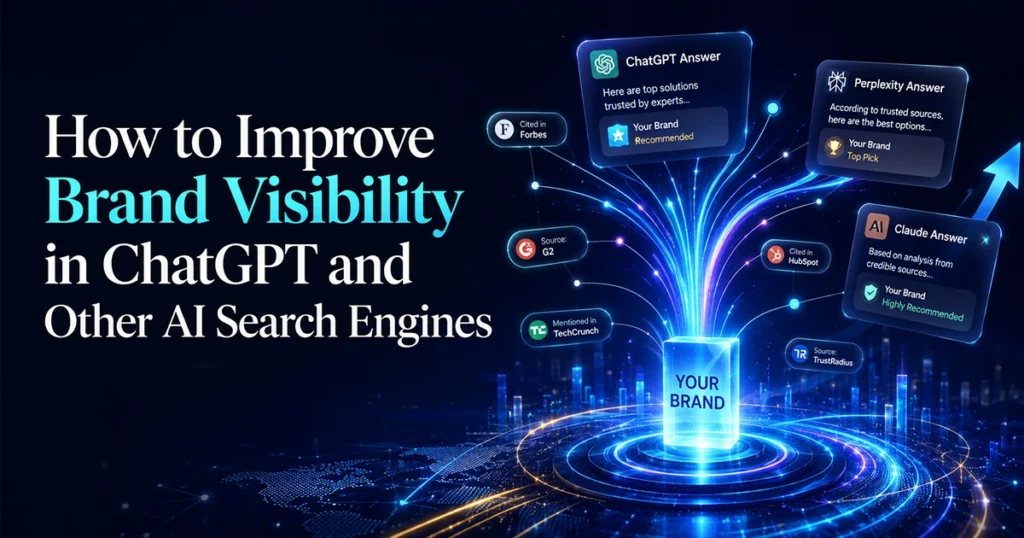
Getting better Brand Visibility in ChatGPT is not just about tuning for one single platform, or you know, a one-size-fits-all thing. ChatGPT, Gemini, Perplexity, Claude, and even Google AI Overviews all seem to combine their own mix of training data, real-time web content, trustworthy sources, structured details, and search indexes. So really, the point is building a stable digital presence that these systems keep treating as reliable, even when the exact rules shift a little.
Use these proven strategies to boost your AI brand visibility and keep it strong.
Build Topical Authority Instead of Publishing Random Content
AI search engines tend to favour brands that cover a topic steadily and deeply, not just in bursts.
Like, say your business provides SEO services; don’t only put out posts about SEO. Instead, build wider, more complete content around the whole idea.
- Technical SEO
- Local SEO
- E-commerce SEO
- AI Search Optimization
- Generative Engine Optimization
- Content marketing
- Website audits
- Keyword research
Also, when several pages support one another with internal linking, those AI engines can more easily grasp your subject matter expertise and the way you think about it.
Create Content That Answers Questions Directly
AI models look for content that gives clear answers, not just vibes.
Instead of doing those long introductions, start each section with a short response, then later explain the whole topic in more detail.
- Definitions
- Step-by-step guides
- Checklists
- Comparison tables
- FAQs
- Pros and cons
- Industry examples
This general flow boosts the odds that your content ends up being pulled into AI-generated summaries.
Strengthen Your Brand Entity
Modern AI search is shifting from keyword recognition to entity recognition, you know.
An entity is a clearly identifiable business, person, product, or organization that AI systems can sort out across different sources, even when the wording changes a lot.
To strengthen your brand entity:
- Keep your business name same everywhere.
- Use the same logo and branding.
- Keep the contact details accurate
- Make sure your business profiles are fully completed.
- Publish author information.
- Link your social profiles with your website.
That way, AI can connect all online mentions to the same brand more reliably.
Earn Mentions on Trusted Websites
AI engines judge authority by looking past your own website.
Try to focus on earning those mentions by, um, going after relevant spotlights.
- Industry publications
- Guest articles
- Digital PR campaigns
- Podcasts
- Interviews
- Case studies
- Customer success stories
- Trusted review websites
These mentions strengthen your credibility and help AI Search Visibility get better too.
Publish Original Insights
Content based only on existing articles rarely makes much of a difference, not really. AI engines tend to really like unique information:
- Original surveys
- Market research
- Customer data
- Case studies
- Industry reports
- Expert opinions
When you publish original insights, it gives AI systems a better reason to point back to your brand, mention it more confidently, even if nobody notices at first.
See also: How to Improve the Website Visibility on Google?
How do Google AI Overviews, ChatGPT, Gemini, Claude, and Perplexity Differ?
This is how different platforms works:
- Google AI Overviews: This leans a lot on Google’s search index, and it tends to surface higher-quality content. It also leans into E-E-A-T (Experience, Expertise, Authoritativeness, and Trustworthiness) plus structured data and solid technical SEO. Overall, websites with comprehensive, well-arranged pages are more likely to show up.
- ChatGPT: This, on the other hand, recommends brands using a mix of what it learned during training and live web information, if that’s available. It seems to care about trusted brands, clear authoritative writing, and consistent online signals. If you build topical authority and keep publishing content led by real experts, Brand Visibility in ChatGPT can improve pretty noticeably.
- Gemini: This is Google’s assistant and uses the Google Search ecosystem along with the Knowledge Graph to make sense of businesses. It often favours fresh updates, strong entity signals, and credible sources. So, keeping pages current and making sure business details stay consistent everywhere can really help visibility.
- Claude: This tends to focus more on giving accurate and somehow context rich answers. It leans toward dependable sources, plus it tries to include explanations that feel detailed and trustworthy too. If a brand releases factual content that’s well researched, then there is a better chance it gets recognized.
- Perplexity AI: This instead uses live web search, and it cites the sources directly, which is important. It aims for newer content, credible publications, and transparent references. Also, adding an original point of view and getting those nods from authoritative websites may help with visibility on the platform.
Best Practices for AI Search Optimization
Businesses that do well with AI search typically stick to a few common things, like the basics but with details.
- Write for people first
If the content is actually helpful and accurate, it usually beats pages that are only made so search systems will notice it. Not the other way around, even when the topic is trendy.
- Use structured formatting
Try organizing information with H2 and H3 headings, plus bullet lists, numbered steps, tables, FAQs, and even clear definitions. When the layout is clean, AI models tend to pull the info and then summarize it much more easily.
- Update what you already have
AI-driven search wants material that feels recent and correct. So, check key pages regularly and refresh outdated numbers, examples, and suggestions. Even small gaps can make a difference.
- Show real expertise
Instead of just saying the usual stuff, add practical direction, real-world examples, and a bit of lived insight.
Benefits of Improving AI Search Visibility
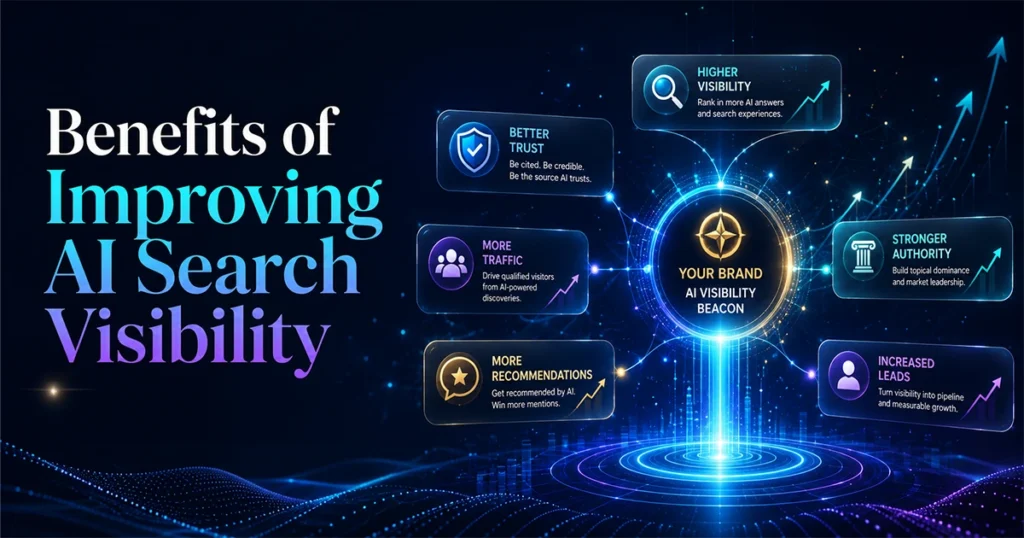
| Benefit | Impact |
| Higher brand recognition | More people discover your business through AI recommendations |
| Better website traffic | Qualified visitors arrive from AI-assisted searches |
| Increased trust | Users see your brand alongside trusted sources |
| Improved lead generation | Better visibility attracts high-intent customers |
| Future-ready marketing | Your strategy adapts to changing search behavior |
90-Day AI Search Optimization Roadmap
Improving AI Search Visibility is ongoing, but most businesses can set up a pretty strong base within 90 days if they stick to a structured approach, sort of like a roadmap you don’t just ignore.
- Days 1–30: Begin with an audit of your website. Sort out the technical SEO glitches, improve page speed, add structured data with schema markup, and make sure your business details are consistent across your website, your social media profiles, and your business listings. This is usually the most unglamorous step but it matters.
- Days 31–60: Now shift attention toward creating high-quality content. Publish deep blogs, FAQs, comparison pages, and original research that actually answer what people ask. At the same time, build authority by getting mentions through digital PR, guest blogging, and publications in your industry, basically get others to reference you in a meaningful way.
- Days 61–90: check what’s happening, then refine the plan a bit. Keep an eye on AI-generated mentions and update content that’s outdated; also, make internal linking stronger, and push the topics that are already doing well. That regular fine-tuning helps build long-term brand visibility in AI, not just a short sprint or whatever.
Key Takeaway: This Optimization isn’t one single task. Keep publishing helpful content and keep reinforcing your online reputation, because the results tend to compound as time goes on.
Challenges Businesses Should Expect
AI search also brings newer problems:
- AI algorithms change a lot, and often
- Different AI platforms prioritize different signals, like relevance, but also something else.
- Brand authority takes time to actually form
- Tracking AI citations is still in motion.
- Meanwhile, the competition for AI recommendations keeps expanding.
So the companies that publish steady, high-quality content will end up with a stronger edge over time.
Expert Tips for Better AI Brand Visibility
Try to focus on solving customer problems first, not just writing content for keywords.
- Build topic clusters, rather than thinking in isolated blog posts.
- You want to earn mentions from authoritative websites, instead of chasing random traffic tricks.
- Use schema markup where it makes sense.
- Refresh the key pages every few months, because relevance drifts over time.
- Publish content that’s research-backed, and try to encourage genuine customer reviews.
- Monitor how AI platforms describe your brand, so you notice misunderstandings early.
Small improvements, done consistently over time, often lead to stronger long-term results than any big one-time campaign.
All Said and Then Done:
AI-powered search is changing how people find, weigh up, and believe brands. Like, simply ranking on Google is no longer enough. Businesses that want to stay competitive have to invest in Brand Visibility in AI Search, by putting out truly helpful content, building topical authority, earning trusted brand mentions, and then sticking to proven AI Search Optimization practices.
The sooner you adapt, the better your odds of being pulled in as a trusted recommendation in ChatGPT, Google AI Overviews, Gemini, Perplexity, and other AI-powered search platforms. Brands that wait ,can end up losing visibility to competitors who are already working on the future of search.
If your business wants to attract more qualified traffic, generate better leads, and build long-term credibility, it’s time to make:
- AI search part of your digital marketing strategy.
- Begin by auditing your existing content, spotting visibility gaps and then rolling out a structured optimization plan.
- Each improvement you make today boosts your AI Search Visibility, and helps place your brand where tomorrow’s customers are actually looking.
FAQ’s
Brand Visibility in AI Search Engines is about how often, and how correctly AI platforms like ChatGPT, Google AI Overviews, Gemini, Claude, and Perplexity mention your company, toss it into a recommendation, or even cite it when someone asks a question. It’s influenced by things like content quality, topical know-how, brand reputation, structured data, plus those trusted online mentions that seem to “count” in the background.
Traditional SEO is more about nudging your website’s rankings up inside typical search engine results. AI search is different, it’s trying to answer straight up in a conversation style, by pulling together information from several trusted sources. Because of that, AI search tends to care a lot about authority, relevance, context, and user intent. So brand credibility and genuinely high quality content start to matter more than keyword positions alone, even if keywords still play some role, just less directly.
You can check your AI brand presence by searching for your products, services, or industry related questions inside platforms like ChatGPT, Google AI Overviews, Gemini, and Perplexity. Then watch if your brand pops up in recommendations, or citations, and note how it’s framed. Also use AI visibility tracking tools together with Google Search Console and your analytics stack, so you can measure what’s happening in a more grounded way.
A few of the best tools people use to track Brand Visibility are Semrush AI Toolkit, Ahrefs Brand Radar, Profound, Peec AI, Similarweb AI Traffic, and Google Search Console. These tools can help you watch for AI-generated mentions, branded search volume, referral traffic, and general visibility across AI-powered search platforms, across time, not just one lucky result.
AI engines usually recommend brands by weighing lots of trust signals, like content quality, topical expertise, website authority, brand mentions on reputable sites, customer reviews, structured data, and overall online credibility. In general, businesses that keep publishing helpful, accurate, and well-organized information are more likely to get recommended or referenced in those answers.
Brand awareness is basically how familiar people are with your business, while brand visibility is more about how frequently your brand shows up inside AI-generated replies, search results, and broader online recommendations. Even a very well-known name can end up with low AI visibility if it doesn’t have strong authoritative content or if its digital presence is thin.
A brand can boost its Brand Visibility in ChatGPT by posting expert-led content, answering user questions clearly, building topical authority, and also picking up mentions from trusted websites. On top of that, use structured data and keep business details consistent across digital platforms; even small changes matter. All of this makes it easier for AI systems to spot your brand as a dependable source, not just another page.
Common slip-ups tend to be publishing overly thin, or even duplicate content. People then end up leaning only on keywords, and they forget the technical SEO tasks, like schema, indexation, and all that. Another one is not refreshing older posts every so often, and then you have inconsistent business information across pages. Sometimes, people just forget brand authority altogether. When that happens, it becomes harder for AI engines to treat your company like a trustworthy, sort of “safe pick” recommendation.
The best playbook usually includes building comprehensive topic clusters, publishing original content that’s research-backed, using schema markup, strengthening internal linking, earning authoritative brand mentions, optimizing for entities, and routinely updating what already exists. With these steps, your search visibility on AI Search and traditional SEO performance tend to move up together, in a steadier way.
Strong AI brand visibility in search engines raises the odds that your business gets suggested during the whole research-and-decision phase. That helps pull in more qualified traffic, strengthen brand trust, create better leads, and increase customer engagement, which in the end supports long-term business growth.