


In 2026, the question is not really whether businesses should adopt AI anymore.
It’s more like, how fast can they adapt before their competitors manage to do the same? And it depends on execution, not just intention.
A marketing team can now spit out a month‘s worth of campaign ideas in just a few hours. Developers may generate functional code with prompts that are, well, pretty straightforward. Designers can sketch out concepts and variations before they even open traditional software tools. Customer support groups can juggle thousands of inquiries at the same time without losing response speed or quality.
Right in the middle of all this change is Generative AI, a capability that has gone past experiments and testing and basically turned into a core business asset.
What makes it different from the usual “traditional AI” is pretty direct: instead of only interpreting data, it produces something new from it.
So whether you’re a marketer, entrepreneur, content creator, or business leader, getting a clear grasp of what generative AI is matters if you want to stay competitive in today’s digital landscape.
In this blog, we’ll cover generative AI’s meaning, how it works in practice, the major types of generative AI, key generative AI tools people use day to day, and why many experts rank it among the most disruptive technologies of the decade.
What Is Generative AI?
Generative AI is a kind of artificial intelligence that ends up creating brand new content, such as text, images, videos, audio, software code, and designs, by learning patterns from existing data.
Traditional AI tends to identify and predict, while Generative AI does the creating.
| Aspect | Traditional AI | Generative AI |
| Primary Function | Analysis & Prediction | Content Creation |
| Output | Insights, Recommendations | New Text, Images, Videos, Code |
| Examples | Fraud Detection, Forecasting | Chatbots, AI Art, AI Video |
| User Interaction | Data-Driven Decisions | Prompt-Based Generation |
| Creativity Level | Limited | High |
That little difference is part of why Gen AI has become, actually, one of the most talked-about technologies across industries, lately.
See also: What Is an AI Search Engine and How Does It Work?
Why Is Generative AI Becoming So Important in 2026?
A bunch of technological advancements speed things up, and adoption is happening faster than before.
| Factor | Business Impact |
| Improved Computing Power | Faster AI Processing |
| Large Language Models (LLMs) | Human-like Responses |
| Multimodal Capabilities | Text, Image, Audio & Video Creation |
| Lower Adoption Costs | Accessible to SMEs |
| Enterprise Integration | Increased Workplace Productivity |
At the same time, most organizations aren’t treating AI as some distant future investment anymore. Instead, they’re weaving it directly into everyday workflows, like right there in the day-to-day operations.
How Does Generative AI Work?
Even if the technology looks pretty complex, the whole process can be understood through four key phases or stages.
Step 1: Training on Massive Datasets
AI models are trained with billions of bits of information, and it includes:
- Articles
- Books
- Images
- Videos
- Websites
- Software code
The model figures out links, patterns, frameworks, and the contextual meaning, too.
Step 2: Pattern Recognition
The AI spots familiar patterns, kind of like it can see it in the data again and again.
For example:
So if there are thousands of articles about digital marketing, then the model ends up learning, almost automatically:
- Writing structures
- Grammar rules
- Tone variations
- Topic relationships
Step 3: Prompt Interpretation
When a user types a prompt, the system reviews what they mean, then predicts the most relevant answer.
Example:
Prompt: “Write a LinkedIn post about luxury real estate.”
The AI then mixes learned language patterns with industry context, so it can craft a response that sounds consistent with the domain and still feels natural to read.
Step 4: Content Generation
The model ends up creating output that is completely new, like, hasn’t existed anywhere before.
This may include:
- Articles
- Emails
- Visuals
- Videos
- Presentations
- Source code
See also: What Are AI Agents and How Do They Work?
What Is the Main Goal of Generative AI?
One of the most searched questions today is, ” What is the main goal of generative AI?” The answer is pretty straightforward.
Core Objective
The primary goal of Generative AI is to help people do more by producing useful content, handling the same repetitive chores again and again, and speeding up how quickly we can solve problems in practice.
Its big aims also seem to lean toward:
✔ Increasing productivity
✔ Enhancing creativity
✔ Reducing operational costs
✔ Supporting innovation
✔ Personalizing customer experiences
✔ Improving business efficiency
Rather than wiping out professionals, Generative AI is turning into this kind of powerful co-pilot, supporting teams day to day.
Types of Generative AI
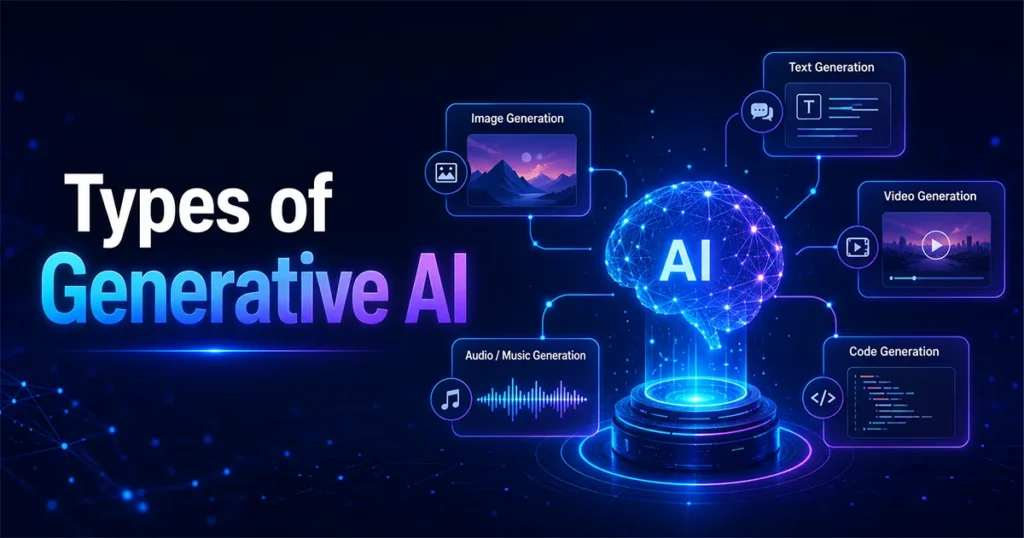
Understanding of the different kinds of generative AI, sort of helps businesses decide what solutions make the most sense for them.
1. Text Generation AI
Text Generation AI is built to produce written material that feels humanish, or at least very close. It can churn out blog articles, emails, product descriptions, social posts, short reports and marketing copy pretty much within seconds. This is also one of the most widely picked up forms of Generative AI, especially for content creators, marketers, and customer support teams, who want faster drafts without losing the tone.
2. Image Generation AI
Image Generation AI makes new visuals starting from text prompts, or whatever instructions the user adds. Like, some companies use it for advertisements, concept art, product mockups, branding assets, and also those social media visuals. The big thing is that it reduces the time wasted on design revisions, so the creative workflow moves quicker.
3. Video Generation AI
Video Generation AI lets people make and revise videos with little manual work, sort of. These tools can output promotional videos, training modules, product demos, and social media material while automating things like scene generation, cutting and assembling, subtitles and voice synchronization, all together. In other words, less busywork, more output.
4. Audio Generation AI
Audio Generation AI is about creating audio-focused content. This can include voiceovers, podcasts, music compositions, narration, plus speech synthesis. More and more companies use these solutions for content creation, virtual helpers, audiobooks and multilingual interaction, even when time is tight or coordination is difficult.
5. Code Generation AI
Code Generation AI helps developers, in a kind of hands-on way, by producing software code, little scripts, documentation, and even debugging suggestions. With these tools, the software development process can speed up noticeably, and coding becomes more efficient. Teams also manage to cut down the repetitive stuff, while keeping their productivity steady, and not losing too much time.
6. Multimodal AI
Multimodal AI is one of the most advanced categories in Generative AI. Unlike older models, which usually stay in just one format, multimodal systems can understand and create more than one kind of content at the same time. So it can work with text, images, audio, and video, all within a single shared framework, which sounds simple but is actually pretty complex. This means interactions become more sophisticated, and it’s expected to drive a major part of the future evolution of artificial intelligence, overall.
See Also: What is AI in Digital Marketing, its benefits, and how does it work?
Most Popular Generative AI Tools in 2026
Lately, businesses keep putting more money into specialized generative AI tools, and it’s becoming a thing.
| Category | Popular Use Cases |
| AI Writing Tools | Blogs, Emails, Marketing Content |
| AI Image Generators | Ad Creatives, Design Concepts |
| AI Video Platforms | Promotional Videos, Training Content |
| AI Coding Assistants | Software Development |
| AI Customer Service Tools | Chatbots & Virtual Assistants |
| AI Presentation Tools | Business Deck Creation |
These solutions help teams cut down on production timelines a lot, while also boosting scalability in a steadier manner, like from one cycle to the next.
Overall:
The talk about AI has been moving pretty fast, but really figuring out what generative AI is, day to day, is sort of the first step toward using it more completely.
Generative AI, like, isn’t just about chatbots or churning out content. It also bleeds into marketing, real estate, healthcare, and even software development, you know, generally speaking. In a lot of situations, gen AI is reshaping how companies operate, discover new ideas, and ultimately compete with each other.
And as new flavours of generative AI keep showing up, along with more capable tools rolling into the market, firms that adopt responsible AI in a careful, thoughtful manner will probably be in the best position to succeed in a more digital future.
See also: What Is GEO Meaning and How Is It Used in Digital Marketing?
FAQ’s
Generative AI is kinda a type of artificial intelligence tech that can cook up original content by learning patterns from huge datasets and then spit out responses based on whatever prompts a user throws at it.
Traditional AI mostly leans on analyzing and predicting data. But Generative AI usually goes for making brand new material—like text, images, videos, audio, and code—almost like it’s starting from scratch, or at least it feels that way.
Some of the better-known generative AI tools include ChatGPT, Gemini, Claude, Midjourney, Adobe Firefly, GitHub Copilot, and Runway, not that this is an exhaustive list or anything.
The main goal of Generative AI is to produce content that’s useful and still original, which can then bump up productivity, creativity, and day-to-day operational efficiency a bit.
As for where it’s heading, the future of Generative AI involves more advanced multimodal systems, autonomous AI agents, real-time content creation, and deeper integration across industries.
In terms of the big categories, Generative AI typically spans text generation, image generation, video generation, audio generation, code generation, and multimodal AI systems, too.
Text-based AI assistants, like ChatGPT, are currently among the most popular and widely used forms of Generative AI, even if people sometimes just think of it as “chat”.
Generative AI can support SEO too, by aiding keyword research, topic ideation, content production, metadata optimization, and overall content strategy building, which makes the process less painful.
Yes, ChatGPT is a Generative AI tool that produces human-like text, and it helps with a variety of language-related jobs.
Generative AI helps companies and people boost productivity, zip up content creation, amplify creativity, cut costs, make customer interactions smoother, and back smarter choices, which, when it sounds simple like that, you might think it’s small, but it adds up really fast.