


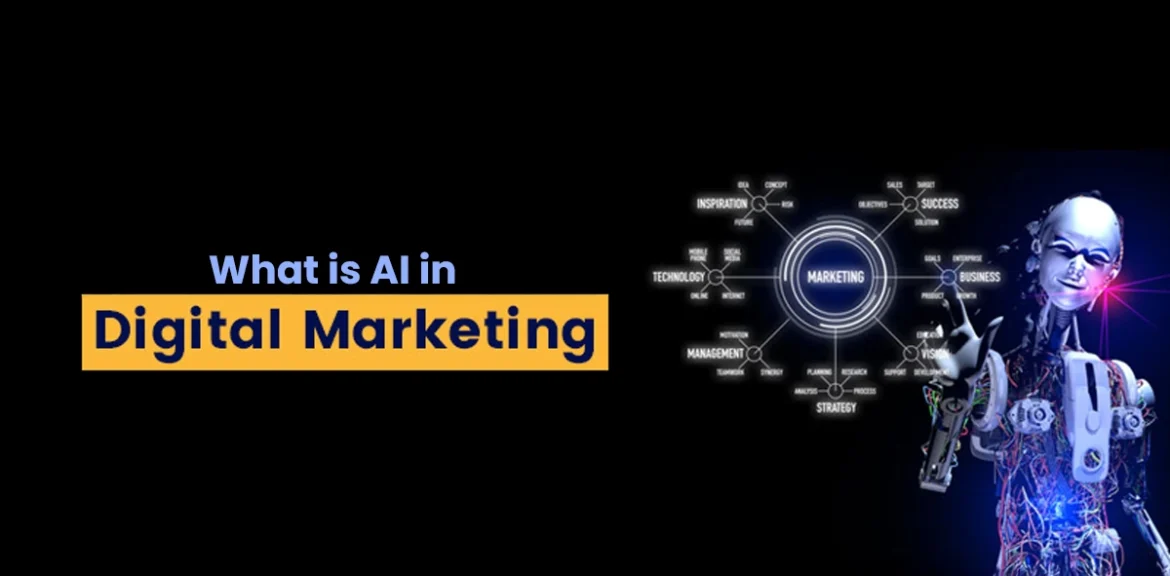
AI in digital marketing has rapidly moved from being merely an experimental technology to one of the main engines of modern digital transformation. One of its most important applications can be found in the marketing field, where data-driven decision-making, personalization, and automation have become indispensable for maintaining a competitive advantage.
Digital marketing with AI allows companies to gain a more accurate understanding of consumer behaviour, optimize their campaigns in real-time, and provide highly personalized experiences on a large scale.
This blog explains what AI in digital marketing is, the role of AI in digital marketing, how it works, and the advantages of marketing AI for businesses in all industries.
What Is AI in Digital Marketing?
The general purpose of AI in digital marketing is that the technology is used in each and every field of artificial intelligence, such as machine learning, natural language processing, predictive analytics, and data automation, to draw up marketing strategies, implement, analyze, and refine such strategies.
In contrast to all classical aspects of marketing tools that carry pre-programmed rules which require manual inputs for operation, AI in marketing systems learns from large volumes of data, finds its patterns, and keeps improving the outcome with very little human intervention. These systems can ingest customer data from multiple touchpoints such as websites, social media, email campaigns, CRM platforms, and paid advertising channels.
Basically, AI changes digital marketing from being reactive to a proactive and predictive discipline.
The Role of AI in Digital Marketing
In Digital Marketing AI, it’s all about getting customers from acquisition to retention and loyalty. There isn’t a single thing about decision or execution which is not improved by AI.
Data Analysis & Customer Insights
AI can sift through mountains of data quickly and surface trends that human analysis would take ages to find. This, in turn, helps marketers:
- Know what a customer prefers and what his/her intent is
- Identify segments of high-value audiences
- Anticipate future buying behaviour
Scaling Personalization
AI helps a brand to personalize the content, offering, and recommendations for each user based on behaviour, demographics, and the history of engagement of the audience.
Campaign Optimization
AI is constantly in the background evaluating campaign performance to maximize ad spending by adjusting bids, targeting, creatives, and timing to improve the overall ROI.
Automation of Repetitive Tasks
Scheduling emails, publishing ads, audience segmentation, and performance report preparation are all tasks that lend themselves to automation and eliminate the manual effort that could lead to errors.
See also: Top 10 AI Content Rewriter Tools for 2026
How Does AI in Digital Marketing Work?
When exploring AI in digital marketing, it is critical to discover its major components and the workflow it would use.
Data Collection
Collects structured and unstructured information from several sources that include:
- Website analytics
- Social media interaction
- Email engagement metrics
- Customer relationship management systems
- History of purchases and transactions
Data Processing and Learning
- It has been used over time, with the outcome of time being learned with prediction models.
- Machine Learning algorithms process this data to identify correlation, trend, and anomaly.
Decision-Making and Prediction
Through the AI models, insights can be generated.
- Which audience is ready for conversion
- Display when and where for impact maximization
Execution and Optimization
Within real-time tracking of performance data, AI tools automatically manage marketing actions and fine-tune them continually.
See also: How to Boost SEO Content Writing With AI Tools?
Applications of AI in Marketing
Artificial Intelligence is said to have unparalleled flexibility because of its integration with contemporary digital marketing in many ways:
- Search Engine Optimization: Keyword research, content optimization, and an assessment on how to rank.
- Content Marketing: Topics for digital content, suggestions for digital content, and a forecast of performance.
- Email Marketing: Personalization of subject lines, optimizing send times, and execution of workflow through automation.
- Social Media Marketing: Social media marketing includes sentiment analysis, trend studies, and laser-focused targeted ads.
- Inbound Paid Advertisement: Strategic buying through automated media and bid-optimal strategies.
- Customer Support: Smart chat, e-mailing, or AI-assisted help.
As is observable with all the above applications, AI has already crept into day-to-day marketing processes.
Benefits of AI in Marketing
AI is not just going to improve marketing efficiency, but it also has a direct effect on business growth, customer satisfaction, and even profit.
Elevating Customer Experience
Real-time personalization enables the delivery of relevant content and offers to each customer based on their interests and needs.
Enhanced Decision-Making Quality
The insights driven by AI are data-based rather than assumption-based, leaving marketing decisions more accurate and objective.
Augmented Marketing ROI
AI improves targeting, timing, and messaging in campaign performance, thus saving costs on redundancy.
Scope and Speed
AI systems comprise thousands of campaigns and customer interactions that can be managed at once, making it very appropriate for digital operations on a wide scale.
Predictive Capability
With AI, the customer behavioural pattern, demand trend, and come up with campaign impact will be forecasted, moving one from a reactive adaptation to proactive planning.
See also: Difference Between Traditional Marketing and Digital Marketing
AI in Digital Marketing vs Traditional Digital Marketing
| Aspect | Traditional Digital Marketing | AI in Digital Marketing |
| Decision-making | Manual and experience-based | Data-driven and predictive |
| Personalization | Limited and rule-based | Advanced and real-time |
| Campaign optimization | Periodic and manual | Continuous and automated |
| Data handling | Limited datasets | Large-scale data processing |
| Scalability | Resource-intensive | Highly scalable |
Challenges and Considerations
In fact, while beneficial, AI poses certain challenges to organizations:
- Privacy and compliance in data
- Reliance on quality in data
- Cost at start of implementation
- Requirement of skilled professionals for managing AI systems
It is compulsory to solve those so that one can realize the long-term benefits derived from AI-based marketing programs.
Future of AI in Digital Marketing
AI will also harness ever-increasing hyper-personalization, voice and visual search optimization, predictive analytics, and more intense integration with customer experience platforms in the future setting of AI in digital marketing. Rather than displacing marketers, AI is becoming more of a decision-support system, enhancing human creativity and crystal clear decision-making.
In Short
Artificial intelligence has changed the very structure of digital marketing-from concept to strategy execution and finally the optimization itself. Data analytics, automation, and predictive intelligence are being offered through AI applications in marketing to enhance relevant experiences, facilitate better efficiencies, and measure business results against AI-augmented intervention.
As technology has evolved, the companies that apply AI strategically to their marketing ecosystem will have better grounds to remain ahead in this data-driven digital space.
FAQ’s
AI applications can also be found in chatbots that cater to clients, recommendation engines to help online businesses, personalization tools for email targeting, prospective lead scoring technologies, and programmatic advertisement platforms for future uses.
AI is an example of digital marketing whereby the handling of massive bulk data input, automating marketing in repetitive tasks, personalized experiences through customer engagement, scenarios of campaign optimization in real-time, and supporting data-based decisions across digital platforms begins to bear fruit.
Increased client-oriented marketing efficiency through improved customer experience creation, a return on investment of ideal quality, personalization when and how it is wanted, and optimization bargain enabling precision and operational efficiency.
It does not take backward steps with digital marketers. Rather, AI will give assistance because, with it, all repetitive activities will be taken care of, and insights will be liberated so that marketers can focus on strategies, creativity, and innovation.
Sales and marketing predict demand using AI technologies such as lead scoring, segmentation of customers, personalized content and product recommendations, chatbot customer engagement, automation of the sales process, and predictive analytics to improve conversion and revenues from sales.